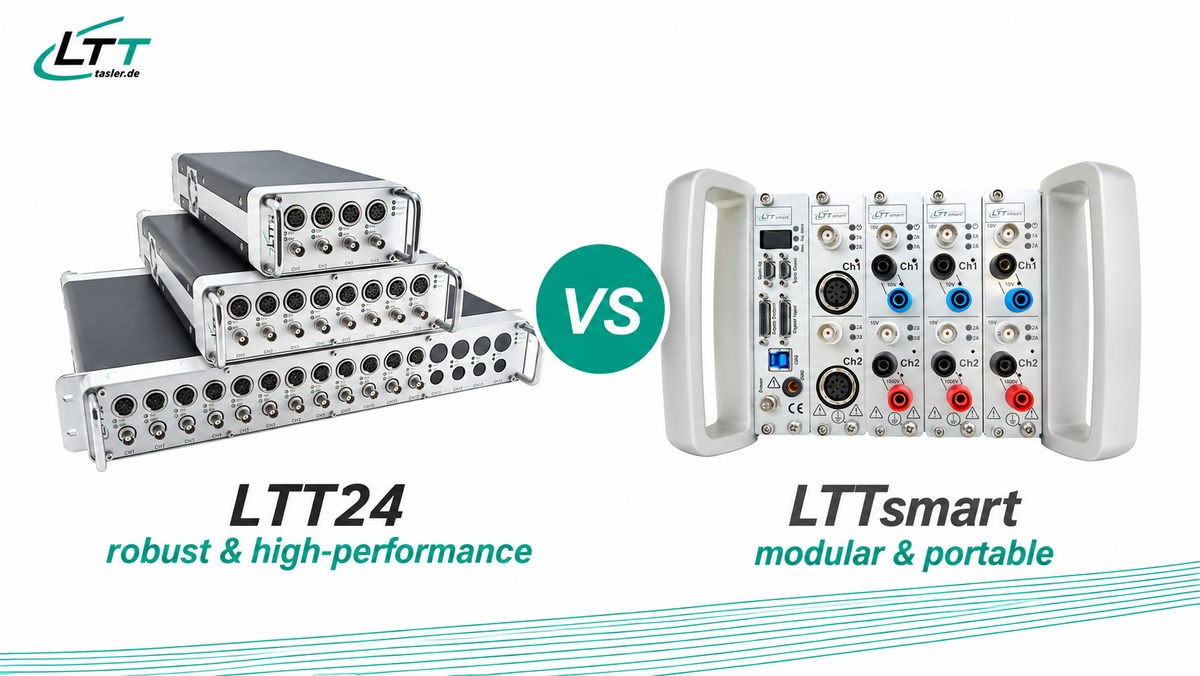
When looking for a data acquisition system, most people don't want to spend too much time weighing up their options – they want to start measuring. That's exactly why we at Labortechnik Tasler have developed two complete systems: the LTT24 and the LTTsmart.
Both deliver highly precise measurement data, yet they are designed for very different applications. Find out how the two devices differ and which one is best suited to your measurement task.
"With our complete systems, we like to put it this way: Plug in the sensor, get the measurement data."
– Michael Tasler, Physicist and Managing Director of Labortechnik Tasler GmbH
What They Have in Common: The Same Measurement Chain Inside
Before looking at the differences, here's the most important thing to know: Both the LTT24 and the LTTsmart use the same technologies and the same carefully calibrated measurement chain internally. The sensor front end, amplification, filters, 24-bit A/D converter, clock, galvanic isolation, power supply and calibration are all precisely coordinated to keep noise and distortion to an absolute minimum.
Michael Tasler explains why this is so important using an analogy from music:
"A measurement chain has to work together like a large orchestra. If even one instrument is out of tune, it affects the quality of the entire orchestra. The same applies to a measurement chain."
This means you get the same signal quality with both devices. The differences lie in their design, features and intended applications.
"Both product families use the same measurement technology internally. But you can already see the difference at a glance: One device is much more rugged and designed for blast testing, while the other is intended for industrial applications with DIN-rail mounting."
– Michael Tasler
The Design: Rugged or Flexible and Portable?
LTT24 – Built for Demanding Conditions
The LTT24 is housed in a solid enclosure milled from a single block of aluminium and equipped with sturdy bail handles. It can withstand harsh conditions, including explosive tests, crash tests and mobile vehicle testing. The rugged enclosure is available in three configurations: with 4 channels (3.7 kg), 8 channels (5.9 kg) and 16 channels (10.4 kg). The downside of this rugged construction is that the larger versions are easier to transport than to handle.
LTTsmart – Modular and Easy to Carry
The LTTsmart consists of individual, slim 2-channel modules housed in aluminium enclosures. The version with large carrying handles can easily be moved from one measurement station to another.
For permanent installation, it is also available in a DIN-rail enclosure (3U). For rack-mounted applications, an industrial version with 32 channels is available in a 19-inch enclosure.
This makes the LTTsmart highly flexible, although it is not quite as rugged as the LTT24. For applications involving extreme mechanical stress, the LTT24 is the better choice.
Comparing the Features
The features required from a data acquisition system depend on your specific measurement task. The table below provides a direct comparison of the key specifications of both devices.
Feature | LTT24 | LTTsmart |
Design | Rugged aluminium enclosure with bail handles | Modular design with 2-channel modules; DIN rail, 19-inch rack or carrying handles |
Channels | 4, 8 or 16 channels (rugged enclosure) | 32 channels in the 19-inch version |
Resolution | 24 bit | 24 bit |
Sampling rate per channel | Up to 4 MHz | 2 MHz (optional 4 MHz) |
Bandwidth | DC to 1.7 MHz | DC to 900 kHz (optional 1.7 MHz) |
Voltage inputs | Up to ±200 V | Up to ±1000 Vrms |
Galvanic isolation | Excellent galvanic isolation: No-Noise DC/DC power supply with a 2 MHz clock | 1500 VDC, all channels |
Sensors | Voltage, current, ICP®, strain gauges, charge, resistance, LVDT, pulse/counter | Voltage, current, ICP®, strain gauges, charge, pulse/counter (depending on the module) |
Measurement without a PC | Yes, as a data recorder with an internal SSD (500 GB) | No, data is recorded on the PC |
Ambient temperature | +10 °C to +40 °C | +10 °C to +30 °C |
Interfaces | USB 3.0, USB 2.0, Gigabit Ethernet | USB 3.0, USB 2.0 |
Key feature | Transient recorder for short, fast events | Power analyser for high-voltage applications and electric motors |
Software | LTTpro, DASYLab, LabVIEW, MATLAB, Famos, FlexPro and others | LTTpro, DASYLab, MLab, LabVIEW, MATLAB, Python, GI.bench and others |
Both systems allow multiple devices to be synchronised, making it possible to acquire data across significantly more channels with precise synchronisation.
Which Data Acquisition System Is Right for You?
The LTT24 is the right choice if you…
- Need to measure under harsh conditions: Blast tests, shock waves, crash tests and mobile vehicle testing require an enclosure that can withstand demanding environments.
- Need to capture short, fast events: As a transient recorder with a sampling rate of 4 MHz and a bandwidth of 1.7 MHz, the LTT24 can capture events occurring within the microsecond range.
- Want to record data without a PC: Thanks to its internal SSD, the LTT24 can also operate as a standalone data recorder, for example in measurement buoys or at locations that are difficult to access.
- Need to reproduce signals: Its analogue outputs allow you to reproduce measured signals or signals generated on a PC.
The LTTsmart is the right choice if you…
- Need to measure high-voltage systems: With inputs of up to ±1000 Vrms and 1500 VDC galvanic isolation, the LTTsmart is designed as a power analyser for electric motors, inverters and power quality applications.
- Are looking for a device for test benches or industrial applications: Its DIN-rail or 19-inch enclosure allows it to be permanently integrated into systems and test benches.
- Want to combine modules flexibly: The 2-channel modules can be configured to suit your measurement task. For example, you can combine high-voltage channels and sensor channels for ICP®, strain gauges or charge measurement in a single device.
- Frequently change measurement locations: The carrying handles make the LTTsmart easy to take with you.
Conclusion: Same Precision, Different Strengths
The LTT24 and LTTsmart do not differ in measurement quality, but in where and how you use them.
The LTT24 is a rugged measurement device designed for dynamic measurements under harsh conditions. It can also record data completely independently of a PC.
The LTTsmart is a modular, portable data acquisition system designed for industrial applications, test benches and high-voltage measurements.
Both follow the same principle: Connect the sensor, select the measurement range and start measuring.
Not sure which measurement device is right for your application? We'd be happy to advise you during a personal demo session.
Do you have any questions? Simply get in touch with us via our contact form or give us a call on +49 931 359 610.