Precision measurement technology for embedded systems
In the past, the role of measurement technology was fairly straightforward: collect, display, and store data. But the demands of modern industry have changed fundamentally.
Today, the focus is on understanding measurement data in real time, analyzing it directly, and comparing it with models. Given the enormous volumes of data generated in the process, intelligence is moving to where the data is collected - directly into embedded systems, machines, and test benches.
But a mathematically perfect evaluation is useless if the underlying numbers aren’t reliable. A data sheet with high specifications is far from guaranteeing a reliable measurement chain.
What really matters:
- Holistic measurement chain: Only the optimal interaction between the sensor front end, amplification, ADC, clock, isolation, supply voltage, and calibration guarantees error-free data.
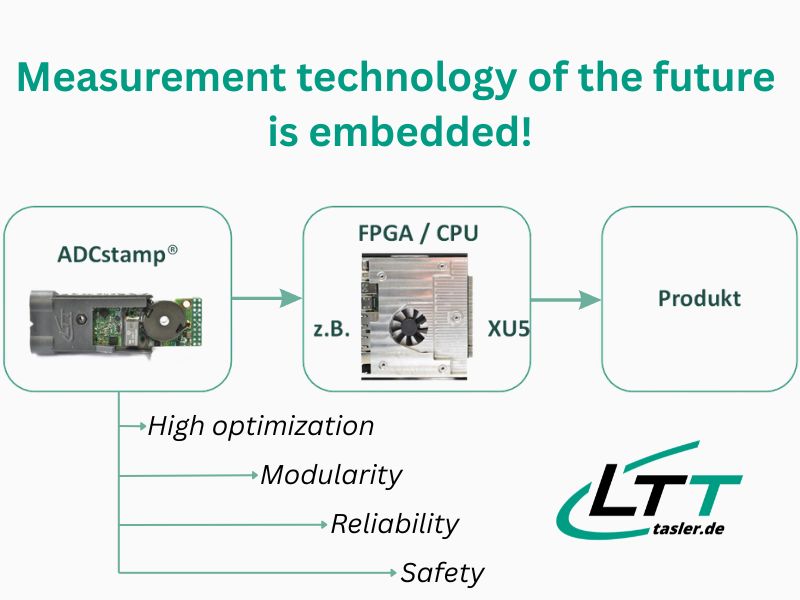
- From ready-made devices to modules: More and more users already have their own computing power (FPGAs/CPUs) and do not need a complete add-on device, but rather precise measurement channels.
- Modularity & safety: Solutions such as the ADCstamp (an AD-converter as a System-on-Module) deliver highly precise 24-bit measurement chains at 4 MSamples/s in an extremely compact form directly to the physical measurement site - including safety certifications such as 1000V CAT II with reinforced insulation.
The future lies in the convergence of highly optimized measurement technology and the embedded world. After all, good measurement technology doesn’t have to be big - it just has to be in the right place and deliver reliable data!