The machine is running, the sensors are in the right place, the measurement device is recording – and yet the measurement curves show nothing but chaos. Often, the cause lies neither in the sensor nor in the software, but in an invisible connection between the measurement channels: a ground loop. Here is a real-world example of just how severe this effect can be.
Case study: vibration measurement on a paper cutting machine
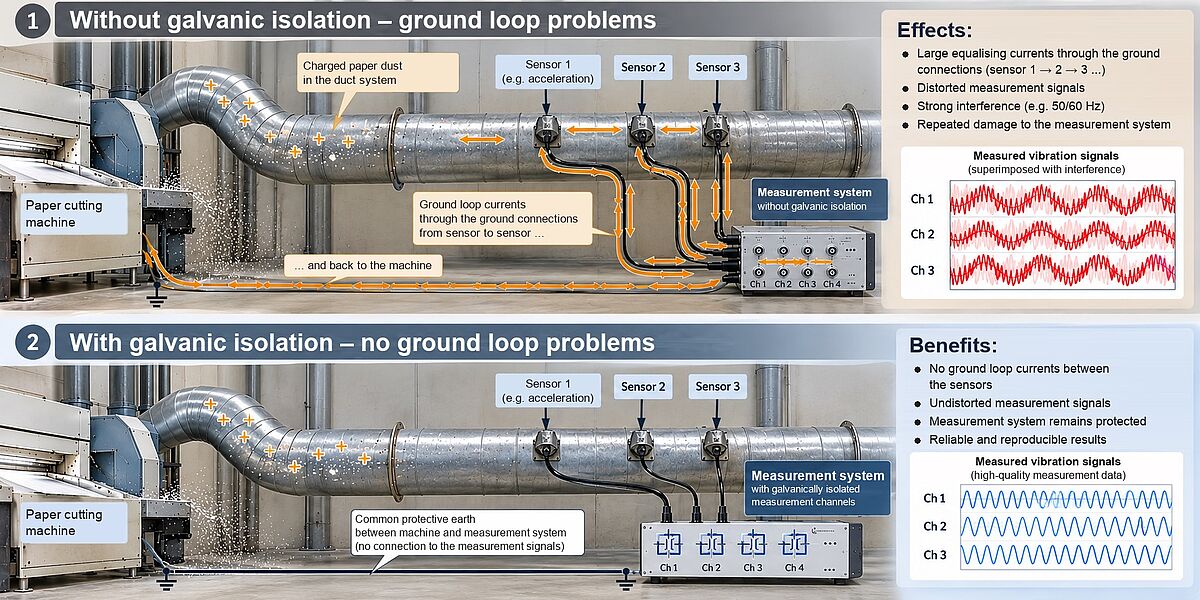
An industrial paper cutting machine operates in a factory hall. During cutting – especially when the air is dry – fine, electrically charged paper particles are produced. A large extraction system removes them and carries them through the entire hall. However, the ductwork is not made of metal throughout: plastic and metal sections alternate. As the charged particles pass through, they electrically charge the individual metal sections – each one to a different potential.
At the same time, the system had to be continuously monitored for vibration, as there were problems with noise and mechanical cracks. For this purpose, accelerometers were mounted on various duct sections and connected to a measurement system.
The result was unusable. In the data acquisition system used, all measurement channels shared the same ground potential. The sensors, however, were mounted on ducts charged to very different potentials. The sensor cables and the measurement device therefore created a conductive path from channel to channel – and through this ground loop flowed equalising currents of, in some cases, several tens of amperes. These currents and their electromagnetic fields completely masked the actual vibration signals. It was no longer possible to make a reliable statement about the condition of the system.
In the end, the solution was simple: a measurement system whose channels are galvanically isolated from one another. Without a conductive connection between the channels, equalising currents could no longer flow – and the vibrations could be measured precisely.
What is a ground loop?
Definition: A ground loop – also referred to as an earth loop – occurs when two or more points in a measurement setup are connected to ground via multiple paths and there is a potential difference between these points. An unwanted equalising current then flows through the resulting loop and is superimposed on the measurement signal.
Current always flows wherever a potential difference and a conductive path meet. In practice, machine parts, test objects, control cabinets and measurement devices rarely share exactly the same ground potential. Typical causes include different grounding points, long cable runs, nearby frequency converters or – as in the case study – electrostatic charging. As soon as the cable shields or signal lines of the sensors connect these points via the measurement device, the loop is closed.
The tricky part: the error does not originate in the sensor or in the A/D converter, but in the interaction of the entire setup. Isolation is therefore one of the most important building blocks of a good measurement chain – on a par with amplification, filtering and A/D conversion.
How can you recognise a ground loop?
In the measurement data, it often shows up as typical patterns:
- Mains hum: A distinct interference at 50 Hz (and its harmonics) in the spectrum.
- Drifting zero point: The offset of a channel shifts although the measured quantity does not change.
- Interference when connecting devices: The signal deteriorates as soon as a second sensor, another device or a PC is connected.
- Dependence on operating state: The interference changes when neighbouring machines, drives or fans are switched on or off.
- Implausible channels: Channels that should be independent suddenly show similar interference signals.
This is particularly critical for automated measurements: if nobody checks the raw data, even the best digital analysis will treat the interference as a genuine measurement signal – and arrive at incorrect results.
The solution: galvanic isolation
Galvanically isolated means that there is no electrically conductive connection between the input of a measurement channel and the rest of the system. The signal is transmitted across an isolation barrier, and the sensor ground remains separate from the ground of the measurement device and the other channels. Because there is no conductive path, no ground loop can form – even if the sensors are at very different potentials.
It is not enough to isolate only the measurement device as a whole from the PC. What matters is that each channel is also isolated from all other channels. Only then can several sensors at different points of a system be measured simultaneously.
In the measurement technology from Labortechnik Tasler, this is standard:
- On the LTT24, all measurement channels are galvanically isolated from each other and from the housing.
- The LTTsmart isolates all channels with 1500 VDC – also important for measurements on high-voltage systems.
- If you want to develop your own measurement systems, the ADCstamp provides a ready-to-use measurement channel with up to 5 kV isolation for your embedded design. Since each module forms its own channel, isolation between the channels can be implemented particularly cleanly.
Which of our two complete devices is right for your application? Find out in our comparison LTT24 or LTTsmart?
Further tips for a low-interference measurement setup
Isolated measurement channels are the most effective measure. In addition, a few basic rules help:
- Ground at a single point only: Connect the ground of the setup in a star configuration at one central point wherever possible.
- Connect cable shields deliberately: Connect shields in such a way that they do not create an additional connection between two grounding points.
- Keep cables short and twisted: Long, loosely routed cables pick up additional electromagnetic interference.
- Check for isolated sensor mounting: Insulating mounting pads can prevent the sensor housing from being conductively connected to the test object. Check whether the mounting affects the frequency response of the sensor.
We have summarised other typical sources of error along the measurement chain – from sensor selection to computational accuracy – in our article Incorrect sensor sensitivities.
Conclusion: isolation is not an extra, but a must
The case study shows how quickly an otherwise correct measurement setup can deliver unusable results. Correctly selected and correctly mounted sensors are of no use if equalising currents mask the signals. Especially in production monitoring and wherever several sensors are located at different points of a system, consistent galvanic isolation of every single channel is a prerequisite for reliable data.
FAQ
Is a ground loop the same as an earth loop?
Yes, both terms mean the same thing. "Ground loop" is common in American English and internationally, while "earth loop" is often used in British English. Both refer to an unwanted current flowing through multiple ground connections.
Can I solve the problem by disconnecting the protective earth conductor?
No. Removing the protective earth (PE) conductor is dangerous and not permitted, as it eliminates protection against electric shock. The safe solution is galvanically isolated measurement channels.
Do I need isolated channels even for small signals?
Especially then. The smaller the measurement signal, the greater the impact of interference caused by equalising currents. Even a potential difference of just a few millivolts can significantly distort a sensitive sensor signal.
What does "1500 VDC isolation" mean for the LTTsmart?
This value specifies the voltage up to which the isolation barrier between a measurement channel and the rest of the system is rated. This allows signals on high-voltage components to be acquired safely and without the channels influencing each other.
Not sure whether your measurement setup is affected by grounding problems? We'd be happy to show you our measurement technology during a personal demo session.
Do you have any questions? Simply get in touch with our contact persons via our contact form or give us a call on +49 931 359 610.