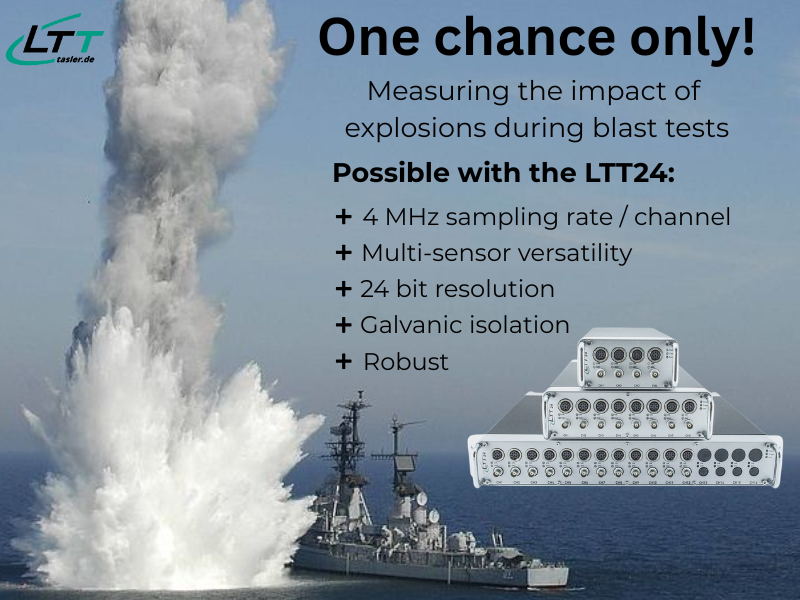
When armor, protective structures, or military vehicles are tested for their resistance to blast effects, enormous forces come into play within fractions of a millisecond. Shock waves propagate at supersonic speeds, material deformations occur instantaneously, and extreme accelerations push sensor systems to their absolute limits.
Explosion tests in a military context are extremely complex, costly, and, above all, generally not repeatable. A single measurement failure not only results in the loss of irreplaceable data but also wastes a massive amount of budget.
What specific demands do these highly dynamic events place on modern measurement systems?
- Sampling rates in the megahertz range: Standard data loggers are far from sufficient for capturing transient shock waves and steep pressure spikes without any loss of information.
- Absolute immunity to interference & EMC protection: The detonation of explosives and the generation of extreme mechanical pulses must not interfere with signal transmission. Complete galvanic isolation is mandatory.
- Phase synchronization & multi-sensor technology: Dozens of channels (pressure, strain, acceleration, temperature) must be recorded with absolute time synchronization to precisely reconstruct the entire physical event.
- Pre-trigger buffering & fault tolerance: Since the exact trigger moment can vary, the system must buffer data in advance and store it locally in the event of a cable break or power failure.
This is precisely where the high-speed measurement technology from Labortechnik Tasler comes into play.
With the LTT24 transient acquisition system, test benches and test centers have access to a solution that was specifically developed for such extreme requirements:
- Up to 4 MHz sampling rate per channel (24-bit): Maximum dynamic range and bandwidth ensure that even the slightest signal nuances remain visible—uncompressed and precise—right next to massive pressure spikes.
- Complete galvanic isolation: Isolated channel by channel—for maximum resistance to ground loops, interference pulses, and electrical arcing during the explosion.
- Multi-sensor versatility: Whether strain gauges, piezo sensors, voltage, or ICP®/IEPE—the LTT24 flexibly processes a wide variety of sensor types in a compact system.
- Absolute data security: The integrated memory ensures that not a single measurement point is lost, even if the data cable is damaged at the moment of detonation.
Whether in defense technology, aerospace, or highly dynamic industrial applications: When measurements must be accurate the first time, you need measurement technology without compromise.
Learn more about measurement technology for blast tests in our application report from the largest test range in Western Europe: