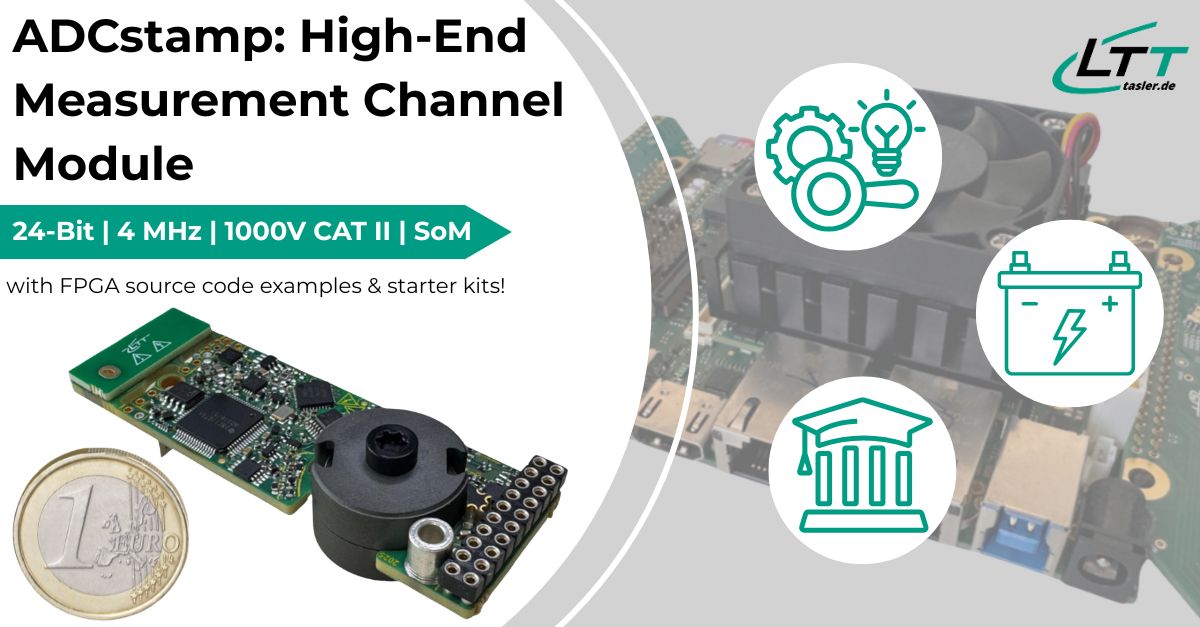
Measurement technology innovation and Messweb Masters Award winner 2024: The AD converter as system-on-module.
Measurement technology is increasingly being integrated directly into devices, test benches, and embedded systems. With the ADCstamp, we are introducing a compact system-on-module that combines high-precision signal acquisition, high bandwidth, and galvanic isolation in integrable designs. This greatly simplifies the development of powerful data acquisition systems.
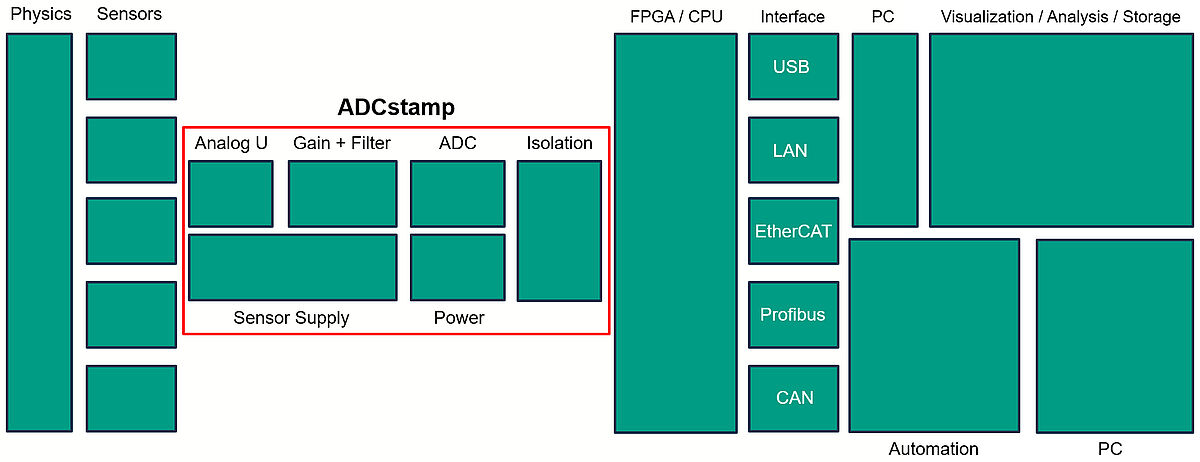
As a single-channel measurement module, the ADCstamp is the ideal component for all developers who, for example, need to integrate fast, high-precision measurement inputs into an existing or new FPGA/CPU design for power analysis of electric motors, without having to worry about the challenges of the analog and digital measurement channels themselves. With this innovation, we offer all hardware developers direct and easy access to our outstanding technology, which we have been successfully marketing for many years in the form of our own measuring devices.
In addition to many other possible applications, the state-of-the-art AD converter module is particularly suitable for precise measurements of electrical signals and the monitoring of high-speed processes. With 5kV galvanic isolation, maximum safety for high-voltage applications is guaranteed. Clear design specifications, FPGA source code examples, and complete starter kits ensure commissioning in just a few minutes.
In short, the ADCstamp offers maximum precision, fast response times and reliable measurements - a revolutionary solution for science and technology.
If you would like to know more, take a look at our brief presentation of the ADCstamp by our expert and CEO Michael Tasler.
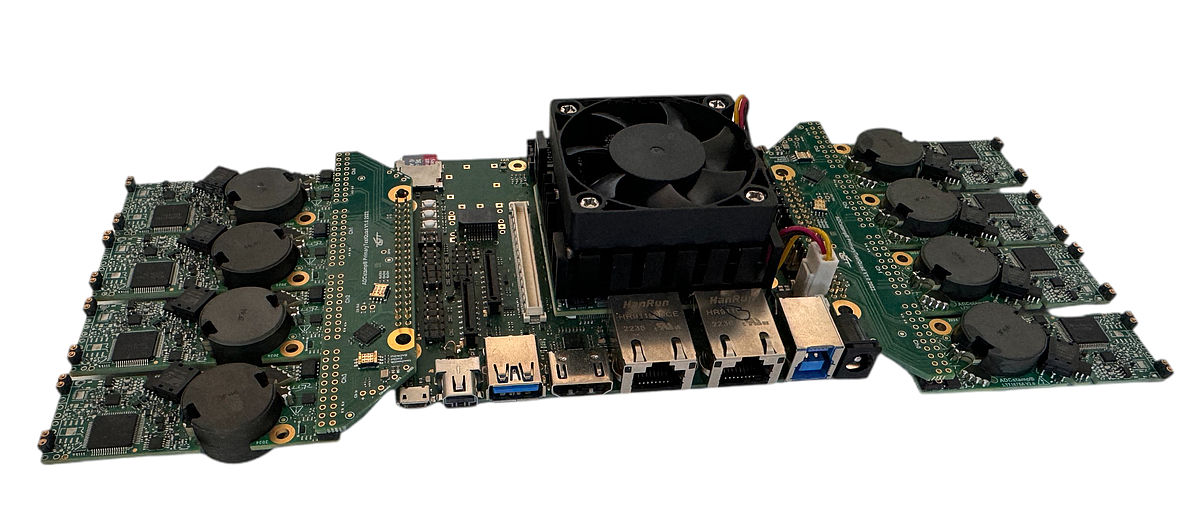
The FPGA Design-In Kit (Evaluation Board / Evaluation-Kit) enables a multi-channel application of the ADCstamp with up to 8 slots.
-Xilinx FPGA Zynq Ultrascale+:
- quad-core Arm Cortex-A53 (APU)
- dual-core Arm Cortex-R5F
- FPGA
- DDR4 (2 GB @ CPU, 512MB @ FPGA)
- Linux with Kernel 5.15.19
-Interfaces:
- USB 3 Host Port, USB 3 Device Port,
- 2 x Gigabit Ethernet incl. IEEE1588 (PTP)
- 2 x CAN,
- EtherCat slave
Sync: PTP, Time Of Day (ToD), 10MHz, 1 PPS, Trigger, ...

Measuring precise electrical signals is challenging, especially in sensitive applications such as sensor development. Even the smallest disturbances in the circuit board layout or EMC problems can impair signal integrity and cost valuable development time.
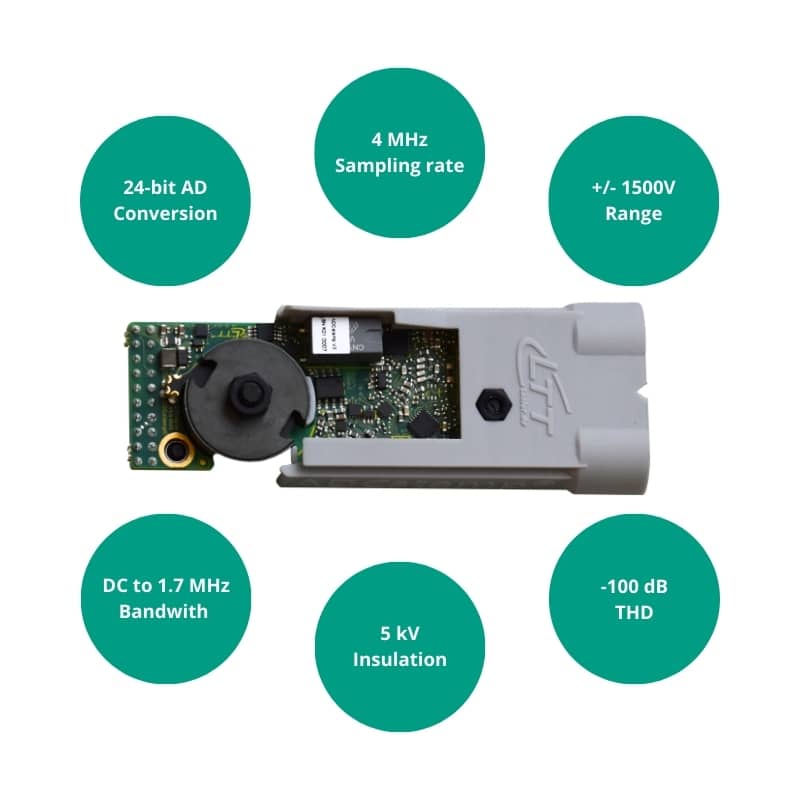
The ADCstamp offers a ready-to-use solution: With 24-bit AD conversion and sampling rates up to 4 MHz, it digitizes analog signals with high precision and reliability. Since the module is already EMC-optimized and well-designed in terms of layout, you can significantly reduce development effort, risk, and time-to-market.
Thanks to its high sampling rate, even fast signal changes in the microsecond range can be captured – ideal for high-speed processes, power electronics, or dynamic test benches.
With a bandwidth from DC to 1.7 MHz, the ADCstamp is suitable for both low-frequency measurements and high-frequency applications, such as in acoustic research or transient signal analysis.
The integrated galvanic isolation reliably protects your measurements from interference – especially in harsh industrial environments with motors, converters, or RF sources.
The modular approach opens up a wide range of applications. Test bench manufacturers can build compact, scalable measurement nodes that can be flexibly expanded. Device developers can integrate precise measurement functionality directly into their products without having to use external measurement devices. And in research, the ADCstamp enables high-resolution measurements in environments where space, weight, or immunity to interference are critical.
The ADCstamp is a powerful ADC system-on-module for precise, fast, and interference-free data acquisition. It minimizes development risks and maximizes measurement quality—in research, industry, and demanding high-tech applications.
An AD converter (analog-to-digital converter, ADC) converts a continuous analog input signal into a digitally coded output signal that can be processed by a digital system (e.g., a microcontroller or computer).
AD converters therefore play a crucial role in measurement technology. An example of this is a temperature sensor that outputs an analog voltage that depends on the temperature. An AD converter digitizes this voltage so that a microcontroller can convert it into degrees Celsius and display it.
You can find more information in our blog post about AD converters.
Did you know that you can test the ad converter module ADCstamp and our other products live? Make an appointment and see the quality of our measurement technology for yourself! We can also present our products via video call to you.
Make a demo appointment